


I’m Jingming Liang (Brighton), a senior undergraduate in Computer Science at Nankai University. I expect to begin my PhD at the Nankai–Baidu Joint Laboratory (NBJL) in 2027. Originally from Dalian, I also pursue minors in Finance and Criminal Law.
I build open-source tools and share learning resources through Lamplighter Commons, and contribute to StarryOS / tgoskits (merged contributions). For research and collaboration, reach me at liangjm@nbjl.nankai.edu.cn.
Research Interests:
- AI Infrastructure (AI Infra): Scalable systems for AI training and inference, with a focus on distributed execution, communication, resource scheduling, and efficient model serving.
- Heterogeneous Computing and GPU Optimization: Hardware-aware optimization across CPUs, GPUs, and NPUs, including efficient kernels and runtimes, with applications to on-device AI under memory and power constraints.
- Embodied Intelligence and Systems Optimization: Efficient execution of perception and decision-making models, with an interest in deployment under real-time, memory, and compute constraints.
🔥 News
- Lamplighter Commons I founded Lamplighter Commons to share open-source tools and learning resources.
- National awards in AI systems Received national third prizes in the Xiandao Cup and Operating System Design Contest, plus Third Prize and the Special Contribution Award in the CANN-HCCL competition.
📝 Projects and Research
Selected Systems Projects

GPU Optimization for All-Pairs Shortest Path
- Designed a memory-aware 3-stage blocked Floyd–Warshall pipeline to reduce bandwidth pressure in dense APSP computation, using shared memory to improve data locality.
- Optimized kernel execution through fusion, dual-stream scheduling, double buffering, and reduced synchronization overhead. Further compressed host-to-device transfer cost from O(V²) to O(E) via custom I/O and device-side graph reconstruction.
- Ranked 1st nationally as an individual competitor, reducing end-to-end runtime by 52.9% on the official hidden datasets (11.50s → 5.42s), equivalent to a 2.12× speedup through profiling-driven optimization and systematic performance tuning.
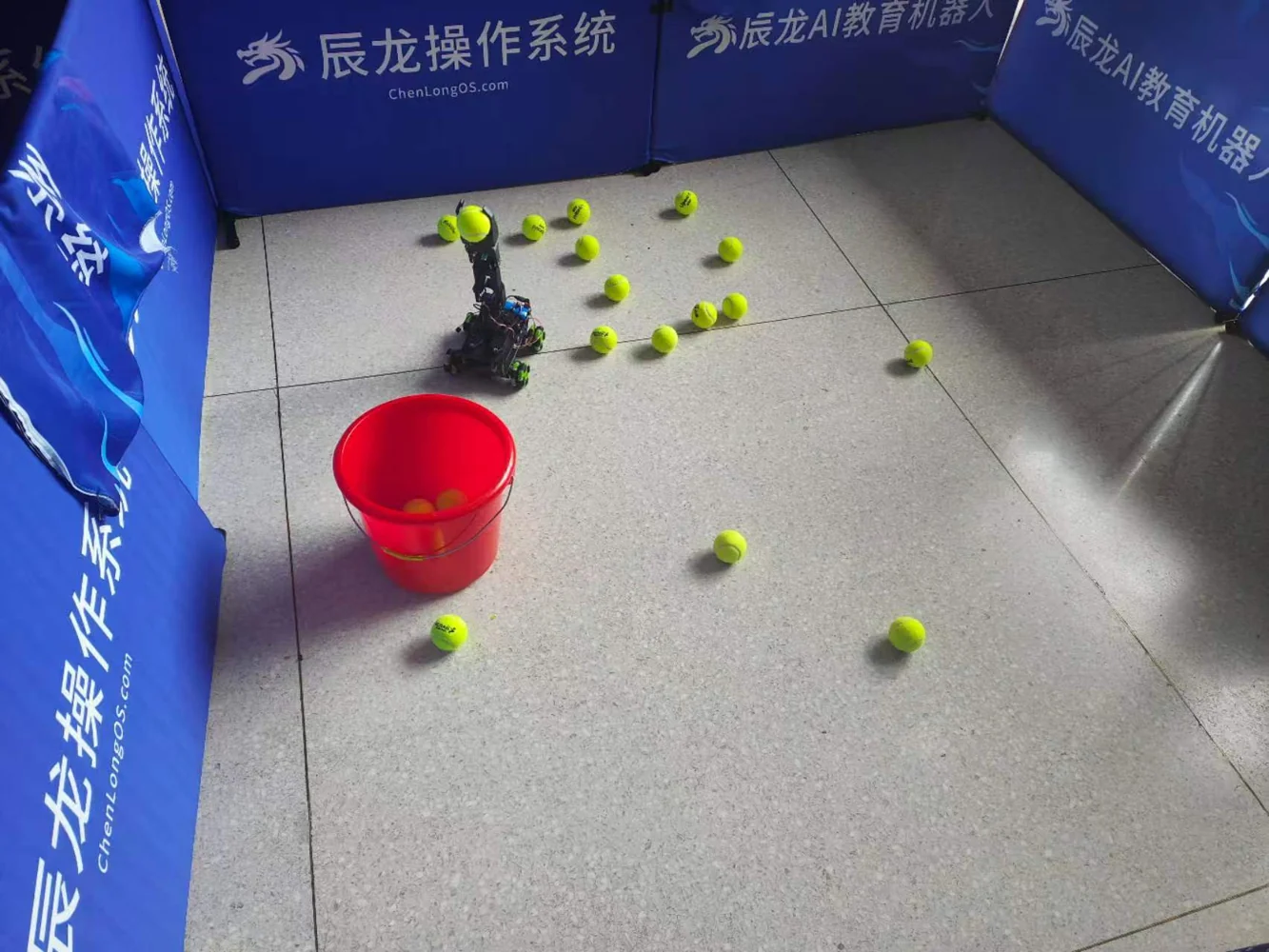
On-Device AIOS on RK3588 and StarryOS
- Integrated UVC image acquisition, RKNN/NPU inference, object detection, and robotic-arm control into a tennis-ball retrieval robot running on RK3588 and StarryOS.
- Diagnosed RKNPU execution and SMP scheduling, fixing hot-path logging stalls and tasks remaining on a single core. In the project measurements, rknn_run latency fell from 817 to 211 ms.
- Improved the four-thread speedup from 0.96× to 3.45× in the project tests; the team received a National Third Prize in the 2026 Operating System Design Contest.
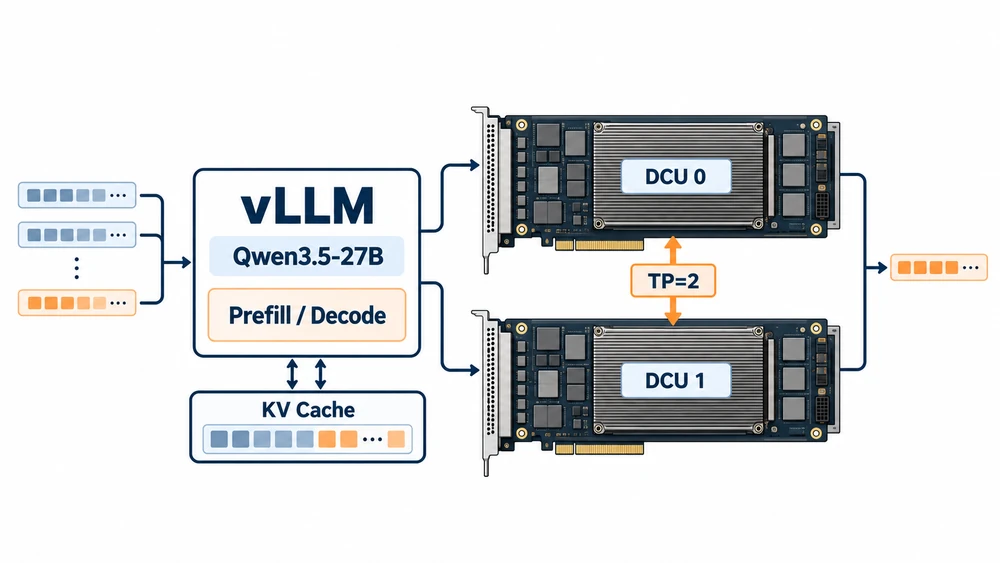
LLM Inference Serving on Domestic DCUs
- Profiled Qwen3.5-27B with vLLM for long-context inference on domestic DCUs, separating prefill/decode bottlenecks and analyzing attention and paged KV-cache paths.
- Optimized compute and memory access with FlashAttention, Triton GEMV, and CUDA Graph, and adapted TP=2 tensor parallelism and Custom AllReduce for two-device serving.
- Completed optimization from individual kernels to the serving pipeline, placing 12th nationally and receiving a National Third Prize in the 2026 Xiandao Cup.
Research
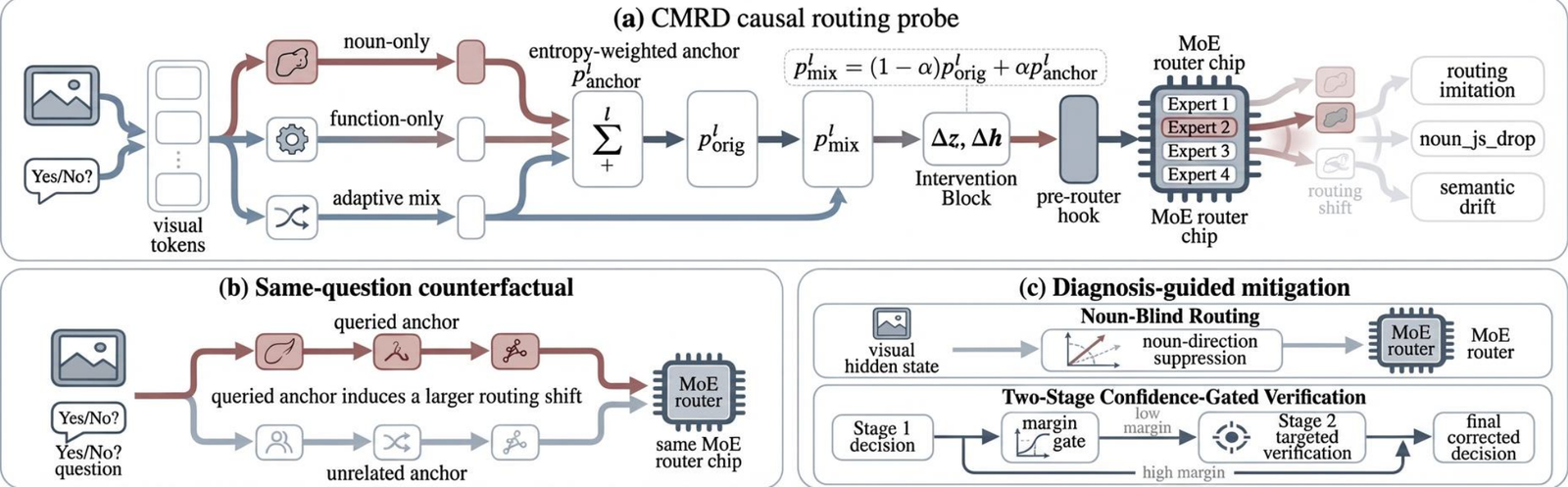
Diagnosing and Mitigating Noun-Driven Routing Bias in Multimodal Mixture-of-Experts
- Developed CMRD (Controlled MoE Routing Decomposition), a training-free probe using text anchors and controlled pre-router interventions to examine noun-driven visual routing shifts.
- Used same-question controls to approximately separate broad-semantic effects from a queried-specific residual, identifying a shared layer-10 routing hotspot in MoE-LLaVA-Qwen.
- Evaluated Noun-Blind Routing and Two-Stage Verification for object-existence hallucination. On POPE-9000, Two-Stage Verification reduced false positives by about 60% and improved accuracy from 81.7% to 88.2%, while increasing false negatives.

Original K-LoRA: Ouyang et al., CVPR 2025. This overview provides background for the K-LoRA++ competition extension.
Adaptive Weight Scheduling for Image Diffusion Models (K-LoRA++)
- Extended the original K-LoRA framework for training-free subject/style LoRA fusion by mathematically formulating and evaluating 8 distinct stage-aware scaling schedules across diffusion timesteps.
- Compared the schedules through first-order derivative analysis and cross-domain experiments; a constant-derivative linear schedule gave the best content/style balance among the evaluated schedules in the tested settings, with less structural distortion and visual jitter.
- Facilitated the end-to-end development of the project’s interactive demo and drove its practical deployment for downstream generative applications.

SparseTSF-FFT: A Frequency-Domain Framework for Time Series Forecasting
- Reimplemented and extended SparseTSF from PyTorch to MindSpore, including custom API mappings and reconstruction of the training/evaluation pipeline for cross-framework deployment.
- Designed an FFT-based learnable filtering module to replace local sliding-window convolutions, aiming to better capture long-range periodic structure under a lightweight parameter budget.
- Conducted cross-framework profiling and forecasting evaluations, observing improved long-horizon performance (e.g., at 336 and 720 steps on ETTh1/ETTh2) relative to the baseline in the evaluated settings.
Other Engineering Projects

RaceRadar: An End-to-End iOS System for Aggregating and Prioritizing Competition Opportunities
- Built a fault-tolerant, multi-source ingestion pipeline that continuously crawls, cleans, deduplicates, and ranks competition announcements, publishing a unified JSON feed through scheduled GitHub Actions workflows.
- Developed a native iOS app in Swift/Xcode with card-based discovery, detailed opportunity pages, deadline-aware prioritization, source/category tagging, and shareable competition posters.
- Designed the system around real student workflows, translating automated data ingestion and ranking into a deployable user-facing information system for discovering higher-quality and time-sensitive opportunities.
Open source
GitHub profileTriangle Light Maze Solver
A solver for triangular-maze questions in online coding assessments at well-known companies. Dynamic programming finds the path that collects the most lights, with interactive results.
- 53 stars
- 7 forks
- JavaScript
- MIT
GitHub statistics as of .
🎖 Honors and Awards
🏆 Competition Awards
2026
Computer System Development Capability Competition — Operating System Design Contest (OS Function Challenge Track)
Computer System Development Capability Competition — Intelligent Computing Innovation Design Contest (Xiandao Cup)
CANN-HCCL Communication Library Innovation Competition
2025
TRAE on Campus Vibe Coding Workshop
3rd National College Student Career Planning Competition - Growth Track, University-level Competition
Computer System Development Capability Competition — Intelligent Computing Innovation Design Contest (Xiandao Cup)
China Undergraduate Mathematical Contest in Modeling (CUMCM)
19th Challenge Cup National Undergraduate Extracurricular Academic Science and Technology Works Competition
Nankai University Mathematical Modeling Competition
8th CCF-TCARCH Computer Architecture Challenge
Pioneer Cup Intelligent Computing Design Competition
Challenge Cup Tianjin Undergraduate Extracurricular Academic Science and Technology Works Competition
President's Cup Innovation and Entrepreneurship Competition - Entrepreneurship Track
President's Cup Innovation and Entrepreneurship Competition - Innovation Track
Mathematical Contest in Modeling / Interdisciplinary Contest in Modeling (MCM/ICM)
2024
China Undergraduate Mathematical Contest in Modeling (CUMCM)
3rd National College Student Data Analysis Popular Science Competition
Teaching, Leadership, and Service
Roles
Teaching Assistant
Student Assistant
Class Monitor & Youth League Branch Deputy Secretary
Service Impact
Selected Honors
Outstanding Communist Youth League Member
Outstanding Student Cadre
Outstanding Team
Outstanding Individual
Leader of the May Fourth Red Flag Youth League Group
Outstanding Class Youth League Branch
Official Representative
Outstanding Officer
🏅 Scholarships
2026
Gongneng Scholarship
Nankai University
2025
Academic Progress Scholarship
Nankai University
Student Service Scholarship
Nankai University
2024
Social Welfare Scholarship
Nankai University
Student Service Scholarship
Nankai University
📖 Education
Nankai University, School of Computer Science
B.Eng. Candidate in Computer Science and Technology
Minors: Finance, Criminal Law.

University of Macau, Faculty of Science and Technology
Admitted to the exchange programme in Computer and Information Science

💼 Internships

UniGrow, Technical Development
- Contributed to UniGrow from initial development to production delivery, working across AI agents, retrieval-augmented generation (RAG), mobile applications, and backend services.
- Developed features and integrated systems, and handled CI/CD, server deployment, and Android/iOS release and maintenance.
- Helped launch a product that reached 1,000+ registered users within two weeks of going live.

Hejun Consulting
- Analyzed financial data from 2016–2024 and recent water-utility market data from Beijing, Tianjin, and Hebei to support industry research.
- Built market-size estimates, competitor comparisons, and regional-attractiveness indicators for equipment and chemical-supply market analysis.
- Prepared a 30,000+ word industry report on the water-treatment equipment and chemicals sector.

ChinaSoft International, LLM Team
- Built an e-commerce knowledge base and RAG workflow, including data collection, structured extraction, knowledge-graph and vector-store integration, and retrieval tuning.
- Fine-tuned a Qwen-based digital persona with supervised fine-tuning and 4-bit QLoRA on an RTX 4060 with 8 GB of memory.
- Deployed the assistant through QQ, connecting model adaptation and retrieval to a working conversational application.

Guotai Junan Securities, Wealth Management
- Cleaned nearly ten years of data across ten asset classes and calculated returns, volatility, and covariance matrices for portfolio analysis.
- Implemented Markowitz mean–variance portfolio optimization to estimate the efficient frontier and a maximum-Sharpe portfolio.
- Examined overfitting in corner solutions and explored adjustments using more recent time-series data.
📡 Technical Communication
Public Engagement
I share computer science study notes and learning resources on Rednote, making course material accessible to a wider student audience.
CS and AI Educational Outreach
Account statistics as of October 2026.
Selected examples of educational content


Beyond Research
Outside computing, I play the violin and classical guitar, with Grade 10 certifications in both from the China Conservatory of Music. I also enjoy volleyball, marathon running, and independent travel.
